
It’s not the disaster you’ve been told it is.
You’ve probably read that everything changes after 40. Your joints hurt, recovery takes forever, you can’t do the things you used to enjoy, and it’s all downhill from here.
But actually, I don’t buy it.
I’ve been training for longer than I care to remember and I don’t feel dramatically different to my 30s. Maybe that’s because I’ve stayed strong and active, or maybe I’ve just forgotten what my 30s felt like.
But the research suggests it’s mostly the first one. The “cliff” people describe at 40 is really a story about people who stopped training, not people who kept going.
Studies on masters athletes show that well-trained people in their 40s, 50s, and 60s maintain muscle mass and recovery capacity remarkably close to younger athletes.
Much of what gets blamed on ageing is actually detraining — doing less because you’ve been told to expect less.
That said, some things do change.
Not as dramatically as many people would have you believe, but enough that a “just keep doing what you’ve always done” approach will eventually catch up with you.
And if you’re coming back to training after a break, your body will feel different to the one you remember.
Whether you’ve been training consistently and want a smarter approach, or you’re returning after time away and want to do it properly this time — this article is for you. I’ve drawn on some of the sharpest minds in strength and conditioning and exercise science to put it together.
Let’s start with a concept I use with everyone who trains with me.
Table of Contents
The Four Things That Matter

We can think about fitness as a flywheel with four quadrants. Each one feeds the next:
- Strength & Resilience — the foundation. Your ability to produce force, protect your joints, and resist injury.
- Movement & Athleticism — how well you move. Power, coordination, balance, mobility — the stuff that keeps you capable and confident in your body.
- Metabolic Capacity — your engine. Heart health, aerobic fitness, the ability to sustain effort and recover between bouts of activity.
- Recovery & Energy — the multiplier. Sleep, nutrition, stress management; everything that determines whether your training actually works.
All four areas complement each other, and if you neglect one, they all suffer.
You don’t want to be the guy who can lift a small truck but can’t climb the stairs without getting out of breath. Or the runner who never touches a weight and always ends up injured.
Or the busy executive who sleeps for 5 hours a night and never seems to make any progress with their training. It’s all connected.
The goal — and it’s written in the middle of my flywheel — is to live life without limits.
Keep up with your kids. Climb mountains. Paddleboard in the sea. Play your sport. Be the person who says “yes” to things instead of sitting on the sidelines.
Let’s go through each quadrant.
1) Strength & Resilience
Strength and muscle are the fountain of youth. Everything is easier when you’re strong. Your joints are more stable, your bones are denser, your metabolism is higher, and you’re harder to break.
Why Muscle Is the Priority
Muscle mass plays a bigger role in longevity than most people realise.
Stuart Phillips, one of the world’s leading muscle researchers at McMaster University, tells us that lean body mass is inversely associated with mortality after 50. In other words, the more muscle you have, the longer you’re likely to live.
But here’s the problem: from around 30, you start losing muscle — slowly at first, then accelerating after 50 to roughly 1% per year if you don’t do anything about it.
Strength drops by 1–2% annually, and our power — the ability to move quickly and explosively — declines even faster.
Why? Because we selectively lose our fast-twitch muscle fibres — the ones responsible for speed, power, and explosive movement.
You can see why people think age is conspiring against them if they haven’t done anything to stop the decline.
Training Hard Still Matters
There’s a popular belief that once you hit 40, you should back off, lift lighter weights, and take things a little easier.
I don’t agree.
Jason Brown makes the case that it’s more important to train hard as you age because the consequences of not training hard are worse.
Power, strength, and muscle mass all decline faster. The things that keep you independent and capable start to slip away.
The key word is “hard,” not “crazy.”
Training hard doesn’t mean grinding through heavy singles, and Brown favours sub-maximal work for people in their 40s and beyond.
He’s also clear that for many people, even those with healthy backs, movements like squats and deadlifts can start to cause niggles, and there’s no such thing as a must-do exercise despite what many in the fitness world might tell you.
Find alternatives which don’t hurt.
Dan John — arguably the wisest voice in strength and conditioning — gives us a workout structure which works for almost everyone: include a push, a pull, a hinge, a squat, and a loaded carry in every session.
That leaves room for a sixth movement — anything you want to bring up a weak point or just enjoy doing.
Dan also has a useful framework for training in what he calls “age bracket three” (36–55).
He suggests introducing more variety, which might be as simple as switching from back squats to front squats and using a mix of reps, sets, and even training times.
You can also work in “seasons”.
For example, you could spend several weeks bodybuilding using machines, before switching to kettlebell work for a period, and then move on to a powerlifting-type approach with barbells. The possibilities are almost endless.
Research has shown that even adults in their 80s and 90s can gain muscle with resistance training. You haven’t missed the boat. Eric Helms makes the same point — your ability to build muscle doesn’t fall off a cliff at 40. The execution just needs more care.
Practical Takeaways
- Three strength sessions per week. Two is fine if you can’t fit in three. Full-body sessions with a different focus each day (for example, a strength day, a ‘bodybuilding’ day, and a power day) is a structure that works well for most people.
- Include power and speed work. Medicine ball throws, jump variations, kettlebell swings, and moving lighter weights fast. This is how you maintain your fast-twitch fibres. • Train close to failure (1–2 reps left in the tank). Training should be hard, but not eyeballs-popping-out-of-your-head, bursting-blood-vessels hard. The results are almost identical but the recovery cost is lower.
- Structure each day based on Dan John’s list: a squat, a hinge, a push, a pull, and a loaded carry. • Make it fun. There are so many possibilities in the gym, there’s no excuse for getting bored.
2) Movement & Athleticism

Being strong is one thing. Being able to use that strength — to move well, react quickly, perform well at sports — is another.
It’s this second part that tends to quietly erode as we get older. Not because our bodies fail us, but because we narrow the ways we use them.
Katy Bowman, a biomechanist and author of Move Your DNA, argues that the decline we associate with ageing is often habit decline, not biology. It’s not that your body can’t do these things anymore. It’s that you stopped asking it to.
Mobility Isn’t Optional Any More
When you’re 25, you can get away with never stretching.
At 45, you can’t. Not because your body is falling apart, but because years of repetitive movement (or lack of it) have created restrictions that affect everything else.
Kelly Starrett, a physiotherapist who’s worked with everyone from NFL players to weekend warriors, puts it well: you can’t cut corners on the margins as you get older.
His approach is about building mobility into your training — not bolting it on as an afterthought you skip when you’re short of time (and we’re always short of time).
Dan John suggests doing mobility work between sets during strength workouts, and it certainly beats doom-scrolling on your phone for 90 seconds.
Bill Hartman’s work goes even deeper. He looks at breathing mechanics as a foundation for movement. It sounds esoteric, but the logic is sound: if your diaphragm isn’t functioning properly, your ribcage position changes, which affects your shoulder and hip mechanics, which affects how you move under load.
For those of us over 40, restoring basic breathing patterns can unlock mobility gains that no amount of stretching or foam rolling will achieve.
Jump, Throw, Sprint
Being athletic isn’t reserved for athletes — the 80-year-old playing golf is still performing athletic movements.
Power, speed, and coordination aren’t luxuries they’re what keep you sharp, capable, and injury-resistant. And they’re exactly the 4 qualities that fade fastest if you don’t train them.
Dan John has long advocated including throwing, jumping, and sprinting alongside your strength work.
The logic is simple: these are the movements that maintain your fast-twitch muscle fibres — the ones you lose quickest with age.
A few medicine ball slams or box jumps before your strength session wakes up your nervous system. And sprinting — even once a week — does things for your athleticism that no amount of lifting can replicate.
If the idea of sprinting makes you nervous, find a hill. Josh Bryant is a big advocate of hill sprints, and for good reason: running uphill is self-limiting.
You can’t reach the speeds that cause hamstring injuries on flat ground. The gradient forces shorter strides, higher knee drive, and aggressive arm action — all the things you want from a sprint, with a fraction of the injury risk.
Start with 4–6 efforts of 8–10 seconds on a steep hill, once a week. Walk back down, recover fully between reps, and don’t treat it as conditioning — this is speed work.
Practical Takeaways
- Spend 5–10 minutes before each session on movement prep — dynamic movements that take your joints through full ranges of motion, and in ways you don’t do in everyday life.
- Do mobility work between sets during your strength workouts.
- Get on the floor regularly. Sit on the floor watching TV. Get up without using your hands. The ability to get up from the floor is another predictor of longevity.
- Include single-leg work in your training. Balance degrades with age, and the best way to maintain it is to challenge it.
- Consider your breathing. If you can’t take a full breath through your nose without your chest and shoulders rising, you have work to do.
- Sprint once a week. Find a hill, warm up thoroughly, and do 4–6 short efforts (8–10 seconds) at close to full speed. Walk back down, recover fully between reps. You’re training your nervous system and body to move quickly don’t confuse it with cardio.
3) Metabolic Capacity

This is the quadrant most people either ignore entirely or get horribly wrong and run themselves into the ground.
Your cardiovascular system underpins everything your ability to train, recover, and stay healthy for the long haul.
Neglect it and you’ll feel the effects in every other quadrant.
Your Engine Is Shrinking
VO2max — your body’s maximum ability to use oxygen — is one of the strongest predictors of longevity.
High cardiorespiratory fitness is associated with a 30–40% reduction in all-cause mortality. Very few interventions — pharmaceutical or otherwise — come close.
Without training, VO2max drops roughly 10% per decade after 30.
Alan Couzens, an endurance coach who’s spent decades working with athletes across the lifespan, puts it like this — to maintain a reasonable level of aerobic fitness, you need roughly 100 hours per year of aerobic training in your 30s.
By your 60s, that number climbs drastically — unless you’ve been building your aerobic base all along. The message is clear. Start now. The work you do in your 40s pays huge dividends later.
Benjamin Levine’s research at UT Southwestern drives this home. His team showed that a structured two-year exercise programme can reverse cardiac ageing by 20 years in people around age 50.
But the same intervention showed no significant improvement in healthy 70-year-olds. The window is roughly 45–55. After that, the heart loses its plasticity.
If you’re in that window, don’t wait to get started.
Most of Your Cardio Should Be Easy
This is where most people get it wrong. They think cardio means always going hard. HIIT sessions till you’re ready to puke. I get it — it feels more productive when you’re working to your limit.
There is absolutely a place for interval training. The body adapts well to hard work.
Steve Magness, author of Do Hard Things, suggests going “manageably hard” once or twice a week — at about 7–8 out of 10 effort.
Tempo runs, hill repeats, or cruise intervals. Hard enough to drive adaptation, not so hard you’re wrecked for days.
But everything can’t be hard or you’ll burn out, and a lot of your aerobic work should be easy. For people just starting out, walking might be enough.
If you’re fitter, running, cycling, or using cardio machines at a conversational pace does the job.
Done consistently over months and years, this is what builds the aerobic base that everything else depends on. It also allows for recovery when done on the days between your strength sessions.
Practical Takeaways
- Aim for 3–4 easy aerobic sessions per week. Walking, cycling, swimming, rowing — it doesn’t matter. 30–60 minutes at a pace where you could hold a conversation.
- Add 1–2 harder sessions per week. Intervals, tempo runs, circuits. Work hard but keep something in the tank.
- Don’t skip the easy stuff in favour of more hard stuff. The aerobic system is the foundation everything else is built on.
- If you use a heart rate monitor, consider HRV-guided training. It adjusts your intensity based on your nervous system’s readiness, which becomes increasingly useful as recovery capacity changes with age.
4) Recovery & Energy

Your ability to recover from training declines faster than your ability to produce force.
A 50-year-old can often lift impressively heavy weights, but the cost of doing so is higher than it was at 25. The training didn’t get harder, the recovery got slower.
This is why it’s so important to think about what happens between your training sessions, not just what happens during them.
You can train hard three days a week but only if the days in between are genuinely easy. That means zone 2 cardio, mobility work, a walk. Not another gym session because you feel guilty about resting.
Sleep: The Non-Negotiable
Matthew Walker’s research on sleep is a bit of a wake-up call. Deep slow-wave sleep — the phase where most physical recovery happens — begins declining in your late 20s.
By 50, you’ve lost roughly half your deep sleep capacity. And 6075% of your growth hormone (crucial for muscle repair) is secreted during that deep sleep.
The implication is obvious. If you’re training hard but sleeping poorly, you’re pouring water into a bucket with a hole in it.
Andrew Huberman’s practical sleep protocols are worth adopting: consistent bedtimes, natural light exposure during the day, minimal bright light after 10pm, and — counterintuitively — carbs at dinner (they support melatonin production).
If you take one thing from this section, make it sleep. You’ll be amazed at how much better everything feels when you’re properly rested.
Nutrition: Protein Is King
Stuart Phillips’ work on anabolic resistance is essential knowledge for anyone over 40.
As we age, our muscles become less responsive to the signals that trigger growth — both from food and from exercise. The fix isn’t complicated, but it does require attention.
Phillips recommends 1.2–1.6g of protein per kilogram of bodyweight per day, spread across 3–4 meals. For a 75kg person, that’s roughly 90–120g daily, or 2535g per meal.
Layne Norton’s research supports this, showing that the per-meal dose matters as much as the daily total — you need enough at each meal to overcome that anabolic resistance.
Don’t underestimate the role carbohydrates play in recovery either.
Carbs are not the enemy — particularly if you’re training hard. They replenish muscle glycogen (your fuel for the next session), help manage cortisol levels after training, and support sleep quality.
Chronically low carbohydrate intake combined with hard training is a recipe for elevated stress hormones, poor recovery, and stalled progress. Eat enough to support the work you’re doing.
Steph Gaudreau makes a point women should be aware of: those in this age group are often under-fuelling, and it can undermine everything they’re doing in the gym.
Hard Days, Easy Days
Here’s how I think about the training week for most people over 40.
Three days where you train with real intent — strength work, power work, hard intervals. On the days in between, go easy.
Easy cardio, mobility, a long walk. These aren’t wasted days — it’s when your body actually adapts to the hard training.
It’s also okay to take a week off from time to time.
Most people won’t need to schedule formal deload weeks — life will interrupt your training often enough that enforced breaks happen naturally.
Holidays, family commitments, a busy week at work — these are your deloads.
Don’t feel guilty about them (unless it’s every second week). And if you’ve been training consistently for a few months without a break, taking a week away from the gym might be exactly what your body needs.
Mike Israetel’s autoregulated approach supports this.
Rather than following a rigid programme regardless of how you feel, you adjust your training volume based on how you’re actually recovering.
Some weeks you’ll feel brilliant and can push. Other weeks, life, stress, or poor sleep means backing off is the smarter option. That doesn’t mean skipping the gym — maybe just knock a set or two off.
If you want a more scientific way to do this rather than just going on how you feel, consider measuring your heart rate variability (HRV) every morning.
HRV is the variation in time between each heartbeat. A higher HRV generally means your body is recovering well and ready to handle stress.
A lower HRV suggests you’re under more strain than usual, whether from training, poor sleep, work pressure, or all three.
Joel Jamieson, one of the leading voices on energy system development, explains that when HRV is low, your body’s ability to adapt to training drops significantly.
You can still do the work, but you won’t get the same results. If you track your HRV (make sure you use a chest strap, not your smart watch), you can make informed decisions about when to push and when to back off.
Practical Takeaways
- Prioritise sleep above all other recovery strategies. 7–9 hours, consistent bedtimes, dark room. Everything else is marginal by comparison.
- Hit your protein targets. 1.2–1.6g per kg of bodyweight, spread across the day. This is the single most impactful nutritional change most people over 40 can make.
- Eat enough calories to support the work you’re doing. Carbs are helpful when you’re training hard.
- Structure your week: three hard days, easy days in between, one full rest day. The magic happens on the easy days and when you’re sound asleep.
- Consider creatine supplementation. Stuart Phillips’ research supports 3–5g daily as safe and effective for older adults, with benefits for muscle mass, strength, and even cognitive function.
The Flywheel Effect
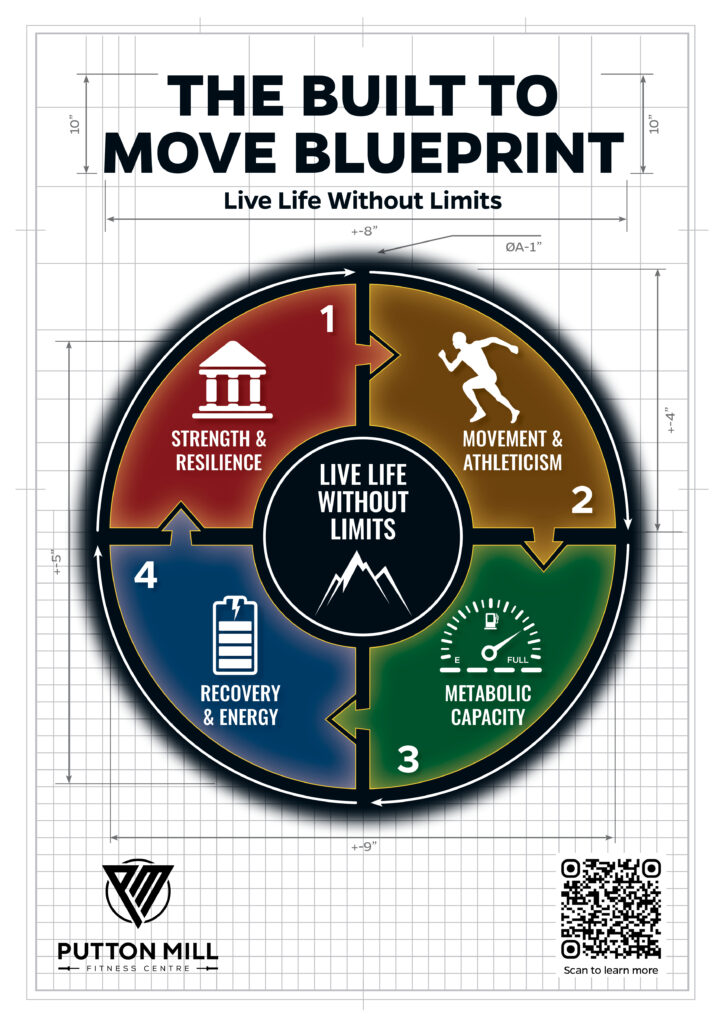
The magic of this framework isn’t in any single quadrant. It’s in how they interact.
When you’re strong, you move better.
When you move well, you can train your aerobic system more effectively.
When your engine is running efficiently, you recover faster.
When you recover properly, you can train harder and more consistently.
And round it goes.
The mistake most people make after 40 is removing the stress entirely (“I’m too old for this shit”) or ignoring the recovery.
Both are wrong. Your body is a system that gets stronger when exposed to the right kinds of stress — and weaker when it isn’t. The dose just changes as you age.
What a Week Looks Like
I’m wary of giving a one-size-fits-all programme, because context matters.
But here’s a template to get you started. Adjust it to your own circumstances.
Monday: Full-body strength session. Heavy emphasis. Big exercises like squat, deadlift, bench press, and pull-ups. 45–60 minutes.
Tuesday: Easy day. 30–45 minute run, walk, cycle, or cardio machine at a conversational pace. Add 10 minutes of mobility work.
Wednesday: Full-body strength session. Repetition emphasis (slightly lighter and higher repetitions). Include single leg work and isolation exercises if you want. 4560 minutes.
Thursday: Easy day. 30–45 minute run, walk, cycle, or cardio machine at a conversational pace. Add 10 minutes of mobility work.
Friday: Full-body strength session. Speed emphasis. Jumps, throws, speed squat, bench press, or deadlift. Finish with higher-rep ‘bodybuilding’ work or some hard intervals. 45–60 minutes.
Saturday: Something fun. A long walk at the beach or in the hills, play sport, or do family activities. You could also fit in a harder or longer cardio effort if you want one.
Sunday: Similar to Saturday, or take it easy and recharge ready for next week.
Three hard days, three easy days, and one rest day.
More than enough to make huge fitness gains while making time for the stuff you enjoy. That’s the reason you’re training, after all.
The Long Game
Let’s finish with a short exercise. Write down the ten physical tasks you want to be able to do when you’re 80 or 90.
Be specific.
Things like: Kick a ball about with your grandchildren in the garden. Get off the floor without help. Play 18 holes of golf. Climb a Munro. Heli-ski in the Alps.
Whatever your list looks like, every one of those tasks requires some combination of strength, movement quality, metabolic capacity, and the recovery to keep doing it week after week.
That’s the flywheel.
You’re not training for a competition (unless you are, in which case — carry on). You’re training for the next 30, 40, 50 years of your life.
And the work you do now determines what that life looks like. Are you sitting on the sidelines or are you living life without limits?
If you have questions about how to apply any of this to your own training, I’d love to hear from you. You’ll get me on bruce@brucemillar.co.uk
Frequently Asked Questions About Training Over 40
Is it too late to build muscle after 40?
No. Muscle growth does not stop at 40. Research shows that even adults in their 70s, 80s and 90s can gain muscle with resistance training. What changes is not your ability to build muscle, but how you support it — adequate protein intake, progressive strength training, and proper recovery become more important. With structured training, you can maintain — and often increase — lean muscle mass well into later decades.
How often should I strength train after 40?
For most people, two to three full-body strength sessions per week is ideal. Each session should include compound movements such as a squat, hinge, push, pull and carry. Training close to failure (leaving one or two repetitions in reserve) stimulates muscle and strength gains without excessive recovery cost. More is not necessarily better — consistency is.
Should I stop lifting heavy weights in my 40s?
No — but you should lift intelligently. Heavy training remains one of the most effective ways to preserve strength, bone density and muscle mass. The key is managing volume and recovery. Sub-maximal work, controlled progression, and exercise variations that suit your body tend to work better than chasing maximal lifts every week.
Is HIIT safe after 40?
High-intensity interval training can be effective, but it should not replace your aerobic base. Most cardiovascular training should be performed at an easy, conversational pace, with one or two moderate-to-hard sessions per week. Recovery capacity changes with age, so intensity must be programmed carefully. Done appropriately, intervals can improve VO2max and metabolic health without excessive strain.
How much protein do I need after 40?
Due to anabolic resistance, adults over 40 benefit from slightly higher protein intake than younger individuals. A practical guideline is 1.2–1.6 grams of protein per kilogram of bodyweight per day, spread across three to four meals. Ensuring 25–35 grams of protein per meal helps stimulate muscle protein synthesis effectively.
Why does recovery feel harder after 40?
Your ability to produce force often remains strong, but recovery capacity declines gradually. Deep sleep decreases with age, hormonal responses shift, and life stress accumulates. Managing sleep, nutrition, training volume and stress becomes more important than adding more training sessions. Structure — not intensity alone — determines long-term progress.
Applying This to Your Own Training
If this framework resonates and you’d like structured guidance tailored to you, I’m happy to help.
Whether you’re returning after time away or looking to train more intelligently in your 40s and beyond, we can build a plan around the flywheel principles outlined above.
You can reach me directly at bruce@brucemillar.co.uk, or enquire through the contact page.
References & Further Reading
The following people and resources informed this article. If any of them catch your interest, they’re all worth exploring further.
Strength & Resilience
- Dan John — Can You Go?, Never Let Go. The Easy Strength protocol. danjohnuniversity.com
- Jason Brown — Functional Conjugate method. Power and dynamic effort training for the over-40s.
- Stuart Phillips, Ph.D. McMaster University. Muscle protein synthesis, anabolic resistance, and protein requirements for ageing. foundmyfitness.com/episodes/stuart-phillips
- Brad Schoenfeld, Ph.D. — Science and Development of Muscle Hypertrophy. Research on muscle growth across the lifespan.
- Gabrielle Lyon, M.D. — Forever Strong. Musclecentric medicine. drgabriellelyon.com
- Andy Galpin, Ph.D. — Fast-twitch fibre loss and power training. Huberman Lab guest series.
- Eric Helms, Ph.D. — The Muscle & Strength Pyramids. Evidence-based training and nutrition.
- Layne Norton, Ph.D. Protein requirements and anabolic resistance. biolayne.com
Movement & Athleticism
- Kelly Starrett, D.P.T. — The Ready State. thereadystate.com
- Bill Hartman — Postural Restoration Institute. Breathing mechanics and movement. billhartman.net
- Katy Bowman — Move Your DNA, Dynamic Aging. nutritiousmovement.com
- Mike Robertson — IFAST. Assessmentdriven programming. robertsontrainingsystems.com
- Josh Bryant — Hill sprint protocols. joshstrength.com
Metabolic Capacity
- Alan Couzens — Aerobic threshold training and endurance across the lifespan. alancouzens.com
- Steve Magness — Do Hard Things. stevemagness.com
- Benjamin Levine, M.D. — UT Southwestern. Reversing cardiac ageing. Published in Circulation (2018).
Recovery & Energy
- Matthew Walker, Ph.D. — Why We Sleep. Deep sleep decline and ageing.
- Andrew Huberman, Ph.D. — Sleep protocols and NSDR. hubermanlab.com
- Joel Jamieson — HRV-guided training and energy system development. 8weeksout.com
- Mike Israetel, Ph.D. — Renaissance Periodization. Autoregulated volume training. renaissanceperiodization.com
- Steph Gaudreau Fuel Your Strength podcast. Nutrition and training for women over 40. stephgaudreau.com
- Molly Galbraith — Girls Gone Strong. Recovery and menopause. girlsgonestrong.com


